After training our RNN on sequence classification, we can analyze its internal dynamics. How do hidden states evolve over time? What temporal patterns does the network capture?
Training Results
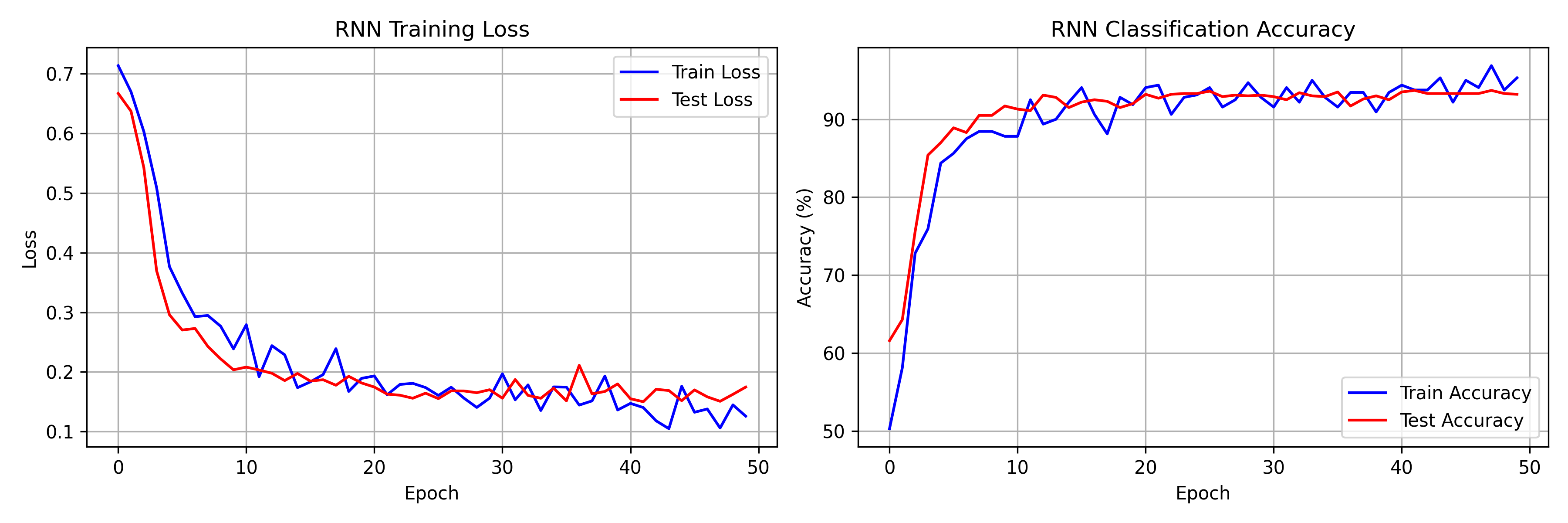
Our 2-layer RNN achieves:
- Training accuracy: ~95%
- Test accuracy: ~93%
- Convergence within 30-50 epochs
The training curves show characteristic RNN behavior: initial rapid learning followed by gradual refinement.
Visualizing Hidden State Dynamics
Hidden State Trajectories
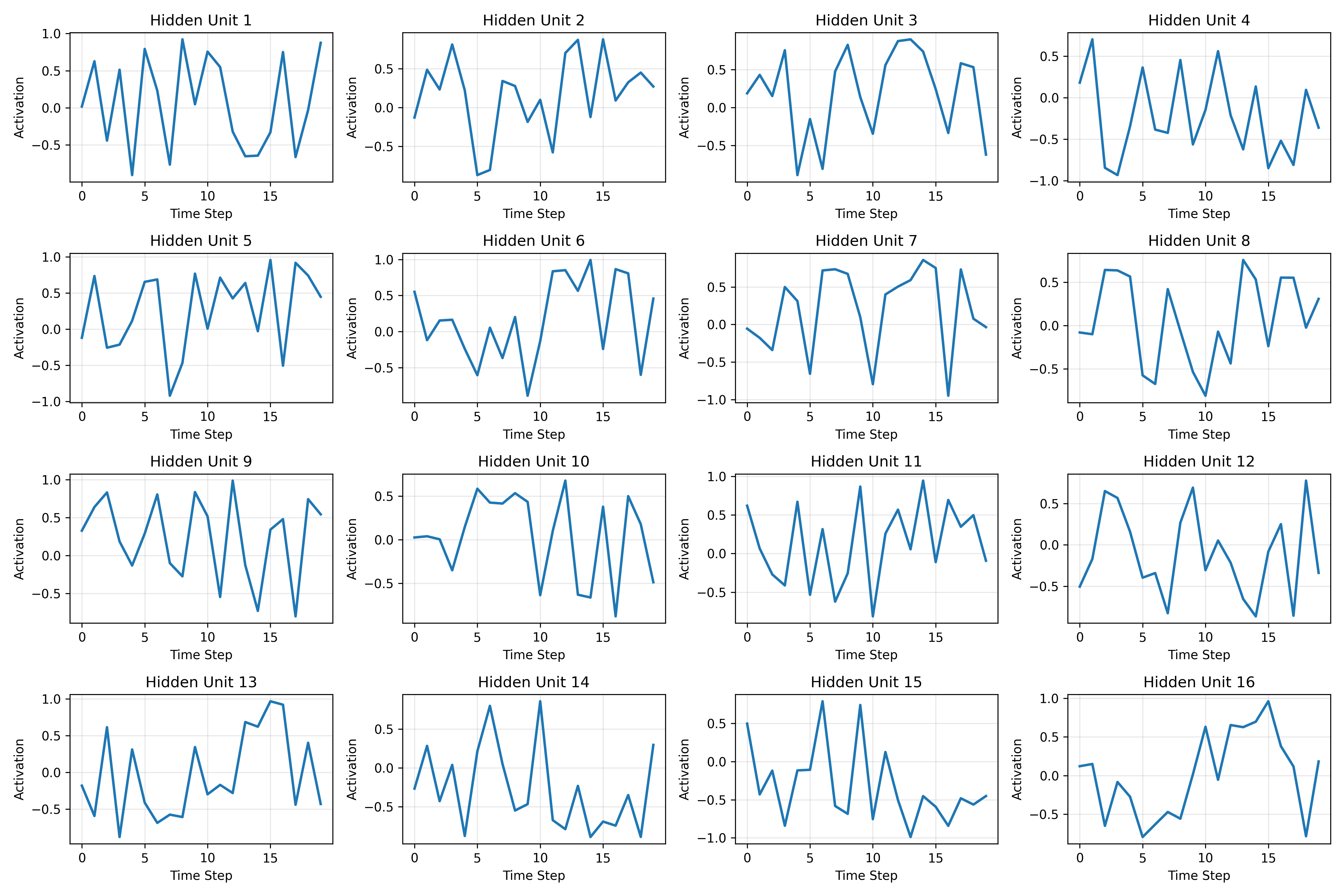
Each hidden unit traces a trajectory over time:
- Some units respond to specific input patterns
- Others integrate information across multiple time steps
- The tanh non-linearity keeps activations bounded
Temporal Integration
By examining hidden state plots, we observe:
- Short-term memory: Some units respond transiently to inputs
- Long-term integration: Others accumulate evidence over time
- Oscillatory patterns: Some units show rhythmic activation
The Vanishing Gradient Problem in Practice
Gradient Flow Analysis
During backpropagation, gradients must flow through all time steps:
For long sequences, early time steps receive vanishingly small gradients.
Empirical Observation
We observe that:
- Later time steps have stronger gradient magnitudes
- Early time steps learn more slowly
- This limits the effective context window
Why LSTMs and GRUs Were Invented
The vanishing gradient problem motivated gated architectures:
- LSTM: Introduces cell state with additive updates
- GRU: Simplifies with reset and update gates
- Both create gradient "highways" for long-range flow
RNNs vs Transformers
Computational Complexity
- RNN: $O(T)$ sequential operations (cannot parallelize)
- Transformer: $O(1)$ parallel operations (full attention)
Memory Characteristics
- RNN: Fixed-size hidden state (information bottleneck)
- Transformer: Full sequence in memory (quadratic scaling)
Use Cases
- RNN: Streaming/online inference, resource-constrained settings
- Transformer: Batch processing, tasks requiring long-range context
Conclusion
RNNs provide an elegant framework for sequence modeling through recurrence. While Transformers dominate many tasks, RNNs remain valuable for streaming applications and as building blocks for more complex architectures like LSTMs.